GutterHawk Roofing & Gutter Specialists


- About
- Roofing
- Gutters
- Areas Served
Killearn Estates
Killearn Acres
Bradfordville
Betton Hills
Lafayette Park
Southwood
Killearn Lakes Plantation
OX Bottom Manor
Summerbrooke
Golden Eagle
Foxcroft
Bull Run
Waverly Hills
Buck Lake Mahan
Piney-Z
Apalachee Ridge Estates
Myers Park
Maclay
Bobbin Brook
Live Oak Plantation
Timberlane
Woodgate
Lake Jackson
Meridian Hills
Midtown
Downtown Tallahassee
Havana
- Financing
- Testimonials
- Recent Projects
6-Inch Seamless Gutters in Tallahassee, FL
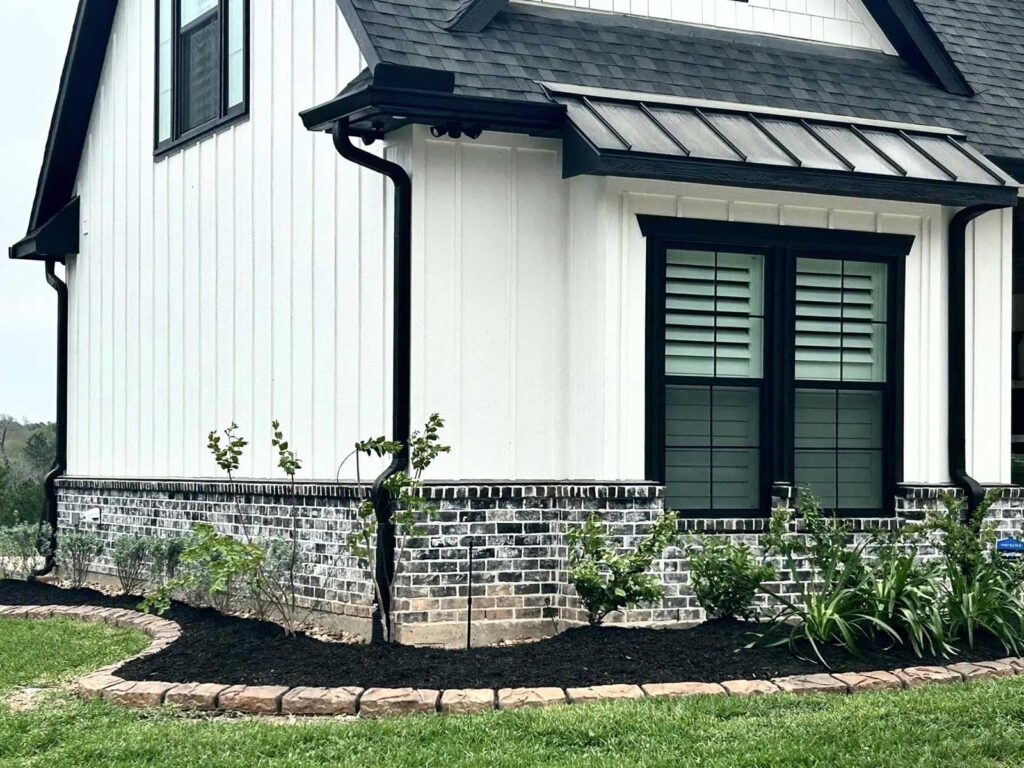
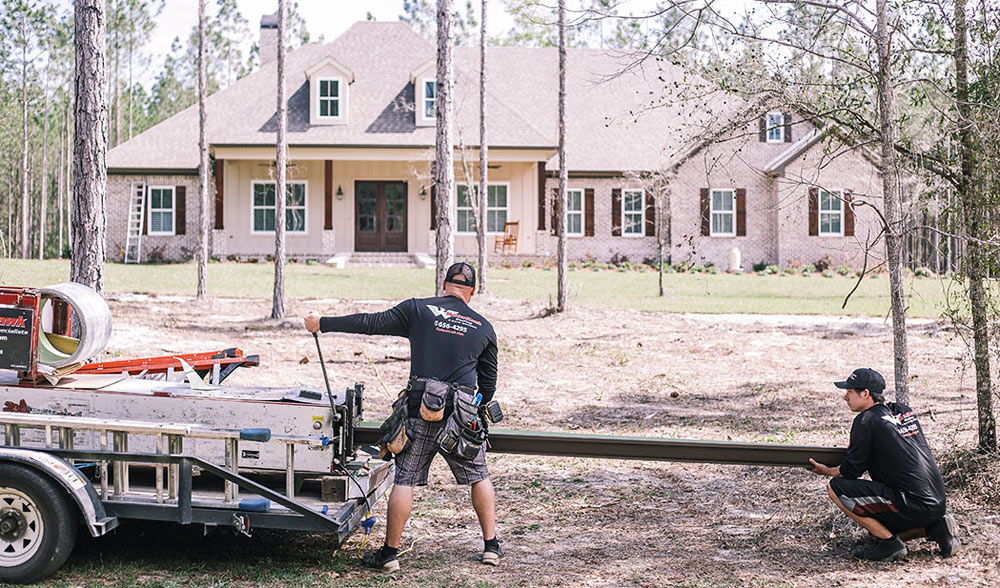
Five-inch K-style is the gutter most builders hang, and on plenty of houses it does the job. On many others it does not, and the first sign is water pouring over the front edge during a summer storm while the gutter is perfectly clean. GutterHawk forms 6-inch seamless gutters in Tallahassee, FL on site from a trailer-mounted machine, cut to the length of each run, for roofs that shed more water than 5-inch can carry.
The extra inch of width adds a lot of volume, because a gutter’s capacity grows with its whole cross-section, not just its width across the top. A 6-inch run also accepts a larger outlet and downspout, and that is often where the biggest gain comes from. This page explains how we decide between the two sizes on a Tallahassee house, one roof plane at a time. If 5-inch is enough for part of your house, we will tell you, and you will only pay for the larger size where it earns its place.
For every size and material we form, see our seamless gutters in Tallahassee page. To keep a wider gutter clear, see gutter guards.
Signs Your Roof Needs 6-Inch
- Water spills over clean gutters in heavy rain
- Large roof planes draining into a single run
- Steep pitch, or a metal roof that sheds fast
- A valley dumping water into one corner
- Long runs with few downspouts
- Heavy oak or pine canopy overhead
- Washed-out mulch or splash marks below the eave
Roof Area and Pitch
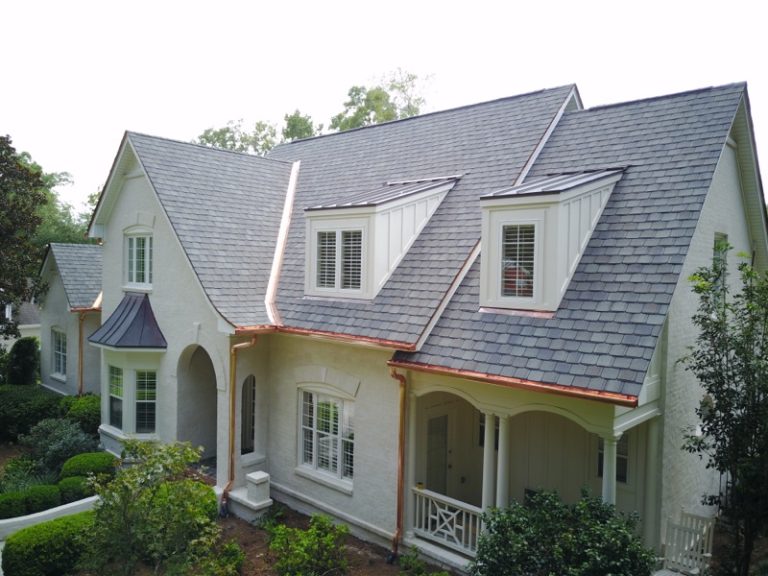
Every gutter run catches the water from the roof plane above it, so the starting point is the area of that plane. A short eave under a small hip drains a modest area; a long rear eave under one wide slope can send several times as much into the same length of gutter. Pitch changes the picture again. Rain on a steep roof reaches the gutter faster and with more force, and on a very steep plane it can shoot across a narrow trough. A metal roof sheds faster still.
We measure each plane and note its pitch at the estimate rather than applying one size to the whole house. It is common for a home to need 6-inch on the back and sides and to be fine with 5-inch on a short front porch, or for the owner to choose 6-inch all the way around so the profile matches on every wall. You will see which runs we recommend at which size, and the reason for each one.
Built for Tallahassee Summer Storms
Tallahassee gets more than 55 inches of rain in an average year, and much of the summer total arrives in afternoon thunderstorms that drop a great deal of water in a short time. Tropical systems add the occasional day of rain that does not let up. A gutter has to be sized for those peak minutes, not for the yearly total, because the overflow that rots fascia and splashes foundations happens at the peak.
A 6-inch K-style gutter holds substantially more water per foot than a 5-inch one, which gives the system headroom when the rain comes down hardest. That headroom also absorbs the ordinary wear of a gutter in service: a little debris at an outlet, a downspout partly blocked by a nest, a slight sag on an older fascia. With 5-inch on a large roof, any one of those can tip the run into overflow. That margin is the case for 6-inch seamless gutters in Tallahassee, FL on any roof that sheds a lot of water.
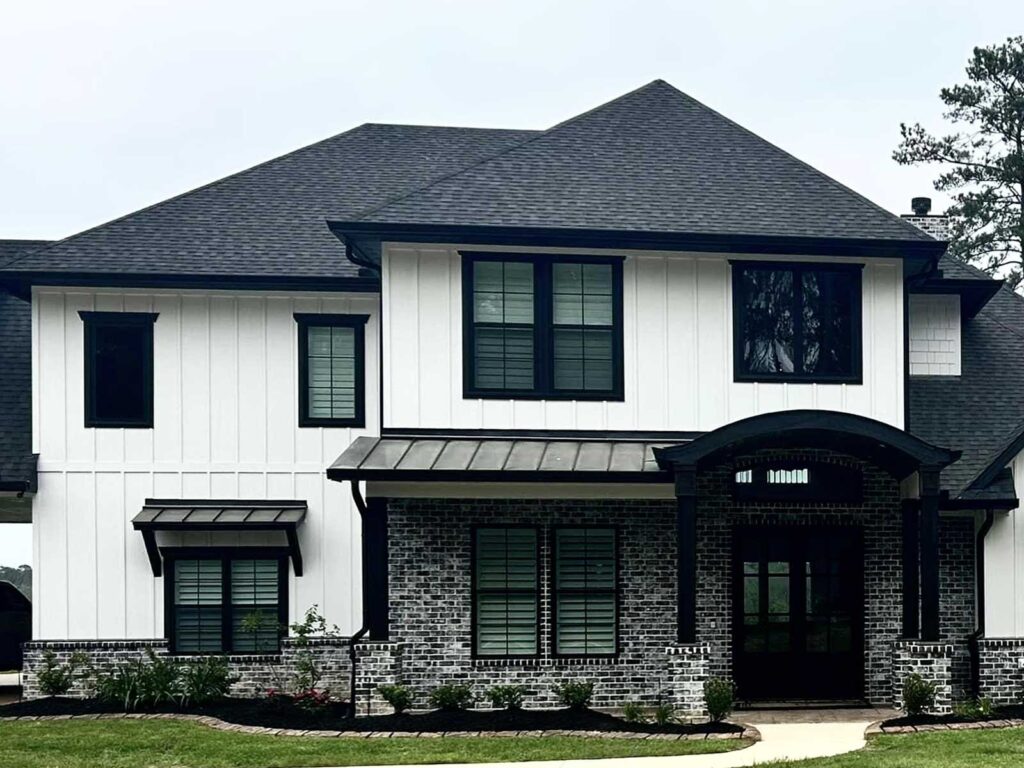
Larger Downspouts, Faster Draining
A gutter only empties as fast as its outlets allow. On a 5-inch system the downspout is often the bottleneck: the trough fills because water cannot leave it quickly enough. Moving to 6-inch lets us cut a larger outlet and hang a larger downspout, which drains a run far faster. On many houses that change does more good than the extra width of the trough itself.
Larger downspouts also clog less. Pine needles, oak catkins and seed pods that would jam a small downspout at the elbow tend to pass through a bigger one. We space downspouts so no run carries water too far before it can drop, add one where a long eave needs it, and plan where each one discharges. Tallahassee’s clay soil is slow to soak up water, so every downspout should end on an extension, a splash block or an underground line that leads water away from the house.
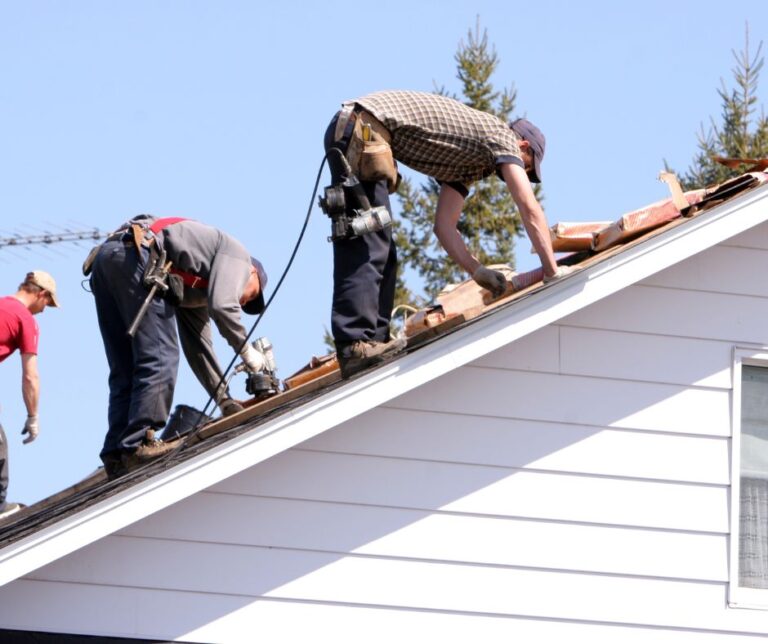
Long Runs and Valleys
A seamless gutter is formed in one piece for each run, which makes long runs practical with no joints along the way. Length still affects capacity, though. The farther water travels along a trough to reach an outlet, the more the gutter is holding at once, and a long 5-inch run can overflow at its midpoint while the ends stay dry. Six-inch gives a long run room, and on very long eaves we may also pitch the gutter toward outlets at both ends.
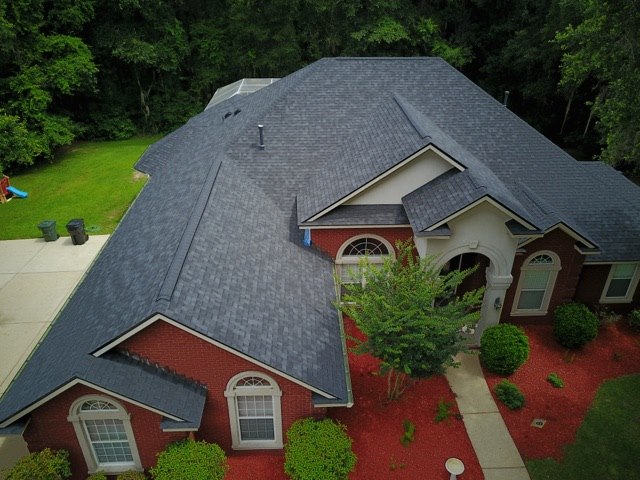
Valleys are the other trouble spot. Where two roof planes meet, the valley gathers water from both and delivers it to a single corner of the gutter in a concentrated stream. In a heavy storm that stream can overshoot a 5-inch corner entirely. A 6-inch gutter at the valley catches more of it, and we often place a downspout close to that corner so the water leaves the gutter almost as soon as it arrives. Because we are roofers too, we also look at the valley itself; debris dammed in a valley can push water sideways across the shingles instead of down into the gutter.
Canopy Debris and Larger Gutters
Tallahassee is known for its tree cover, from the live oaks hung with Spanish moss along its designated canopy roads to the longleaf and loblolly pines in so many yards. That cover is a big part of why people like living here and a big part of why gutters clog. Pine straw mats in the trough, oak leaves and catkins come down in spring, and pollen film coats every surface.
A 6-inch gutter does not stop debris, but it tolerates it better. A wider trough takes longer to block, and a larger outlet passes more of what reaches it. Six-inch is also a sound base for a gutter guard, because the wider gutter leaves more open area for water to enter under heavy rain. If your house sits under heavy canopy, we can talk through guard options on the same visit, since fitting both together costs less than adding guards later.
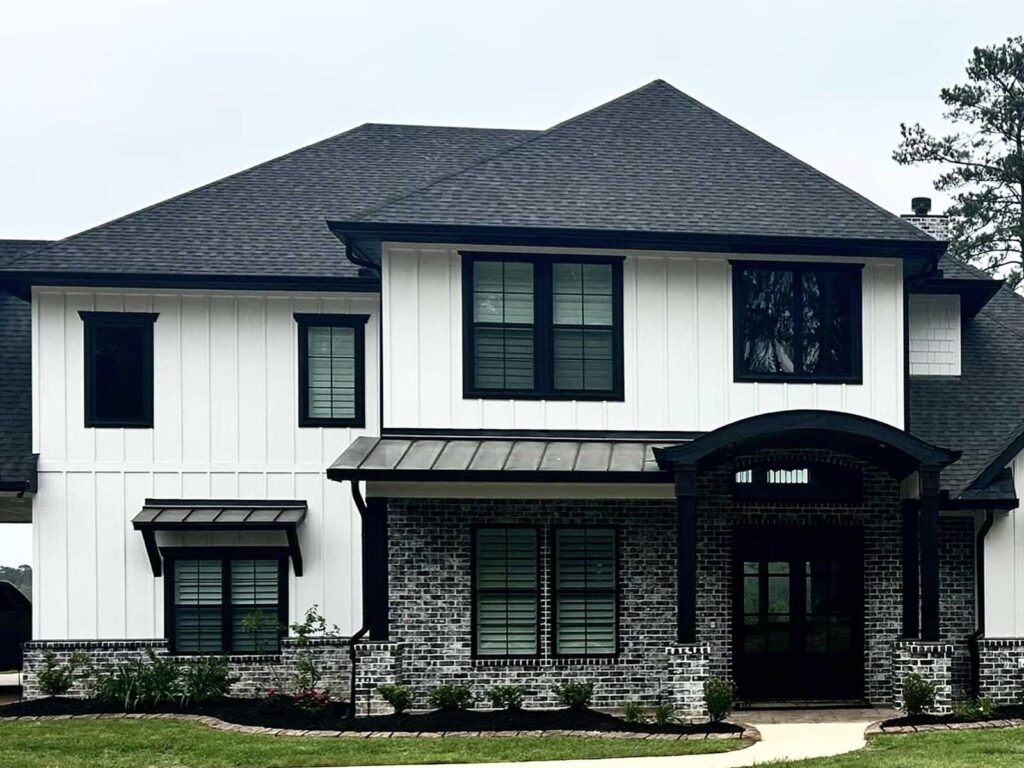
Cost of the Larger Size
Six-inch costs more than 5-inch per linear foot, because it uses wider coil and pairs with larger downspouts and fittings. Weigh that difference against what overflowing gutters damage over time: fascia, soffit, siding, landscaping and the soil at the foundation. As with all our gutters, the price moves with total length, the gauge of aluminum, color, the number of downspouts and the height of the eaves.
We offer aluminum in standard and heavier gauge. The heavier gauge holds its shape better on long runs and under falling limbs, and it is worth considering on a 6-inch system that will carry a lot of water. Your written quote lists the size for each run, the gauge, the color, the downspout count and any fascia repair, so you can see exactly what 6-inch seamless gutters in Tallahassee, FL will cost on your house.
Find Out Which Size Your Roof Needs
If your gutters spill over in storms even when they are clean, they may simply be too small for the roof. Call GutterHawk at (850) 779-1081 and we will measure each roof plane and quote 6-inch seamless gutters in Tallahassee, FL wherever the roof calls for them.
Frequently Asked Questions
How much more water does 6-inch hold than 5-inch?
Substantially more per foot, because capacity follows the cross-section. The larger downspout it allows adds more drainage still.
Will 6-inch gutters look too big on my house?
On most two-story and larger homes they look in proportion. On a small single-story house we may recommend 5-inch where it is enough.
Does a single-story ranch need 6-inch?
Not always. A simple low-pitch roof with short runs is often fine on 5-inch, and we measure before recommending either size.
Can I mix 5-inch and 6-inch?
Yes, run by run. Some owners prefer one size all around for a uniform look.
Do 6-inch seamless gutters in Tallahassee, FL come in colors?
Yes. They are formed from factory-colored aluminum coil to match or contrast with your trim.
Are 6-inch gutters heavier on the fascia?
Yes, when full of water. We check the fascia and set hangers closer where the load is heavy.
Can you change my existing downspouts to larger ones?
Yes. Larger downspouts are usually part of moving to 6-inch.
Q.2 Aluminum or copper?
Aluminum for nearly everyone. Copper for period homes where appearance justifies several times the cost.
Q.3 K-style or half-round?
K-style carries more water for its size. Half-round suits historic homes and sheds debris better.
Q.4 Do I need 5 inch or 6 inch?
It depends on the roof area and pitch draining into each run. Many homes here need 6 inch.
Q.5 Can you match my existing trim color?
Yes. Aluminum coil comes in a wide range of factory colors.
Q.6 How long does installation take?
Most homes are a single day, including removing the old system.
Q.7 How much do seamless gutters in Tallahassee FL cost?
Priced per linear foot, varying with material, gauge, size, and height. We quote after measuring.
Working With Us Is Easy
01.
Request Your Quote
Getting the process started is easy! Simply fill out our quick form or call us at (850) 779-1081. One of our friendly staff members will get in touch to finalize the details.
02.
We Work On Your Estimate
One of our expert estimators will get to to work analyzing your job and crafting a proposal. Of course, we’re here to answer any questions you may have.
03.
GutterHawk Gets To Work!
Contact Us
Have questions about your roof? Do you need information on gutter maintenance plans? No matter the question, GutterHawk is here to help!