GutterHawk Roofing & Gutter Specialists


- About
- Roofing
- Gutters
- Areas Served
Killearn Estates
Killearn Acres
Bradfordville
Betton Hills
Lafayette Park
Southwood
Killearn Lakes Plantation
OX Bottom Manor
Summerbrooke
Golden Eagle
Foxcroft
Bull Run
Waverly Hills
Buck Lake Mahan
Piney-Z
Apalachee Ridge Estates
Myers Park
Maclay
Bobbin Brook
Live Oak Plantation
Timberlane
Woodgate
Lake Jackson
Meridian Hills
Midtown
Downtown Tallahassee
Havana
- Financing
- Testimonials
- Recent Projects
- About
- Roofing
- Gutters
- Areas Served
Killearn Estates
Killearn Acres
Bradfordville
Betton Hills
Lafayette Park
Southwood
Killearn Lakes Plantation
OX Bottom Manor
Summerbrooke
Golden Eagle
Foxcroft
Bull Run
Waverly Hills
Buck Lake Mahan
Piney-Z
Apalachee Ridge Estates
Myers Park
Maclay
Bobbin Brook
Live Oak Plantation
Timberlane
Woodgate
Lake Jackson
Meridian Hills
Midtown
Downtown Tallahassee
Havana
- Financing
- Testimonials
- Recent Projects
Roof Inspection in Maclay / Maclay Hammock, FL
Along Thomasville Road, the newer roofs of Maclay and Maclay Hammock sit under a heavier oak and pine mix than the open subdivisions closer to town, and that canopy sheds onto valleys and behind chimneys in spots a homeowner never sees from the driveway. A roof that looks fine from the street can be holding wet debris in a valley or hiding a cracked pipe boot two years before it shows up as a ceiling stain.
What a Roof Inspection Covers
- Shingle or panel surface — granule loss, cracking, curling, lifted or missing pieces, hail bruising, and how much serviceable life is realistically left.
- Flashing and penetrations — chimneys, skylights, dormers, vents, and pipe boots, which is where most roofs in this area actually start failing.
- Decking and structure — soft spots, sagging, and any sign the sheathing underneath has been taking on water.
- Attic and interior evidence — staining, damp insulation, daylight through the sheathing, and moisture readings where access allows.
- Gutters, drip edge, soffit and fascia — rot and separation at the roofline, plus whether the drainage is doing its job at all.
- Ventilation — ridge and soffit venting, since poor airflow cooks shingles from underneath and voids plenty of warranties.
- Prior repairs — previous patchwork, sealant over sealant, and workmanship that is likely to fail again.
When You Need a Roof Inspection
- After a storm — wind and hail damage is often invisible from the ground, and claims have deadlines. Documented early, it is a much easier conversation with the adjuster.
- Buying or selling — a roof inspection in Maclay / Maclay Hammock FL tells a buyer what they are inheriting and gives a seller something concrete instead of a negotiation based on guesswork.
- Insurance renewal or a new policy — Florida carriers regularly ask for proof of roof condition and remaining life before they will write or renew.
- Before a warranty runs out — worth checking while the manufacturer or the installer is still on the hook.
- Visible warning signs — ceiling stains, granules in the gutters, or streaking and lifted shingles you can see from the yard.
- Age — once an asphalt roof passes ten years in this climate, a condition report every couple of years is sensible.


Storm Damage and Insurance Inspections
Roof Inspection in Maclay / Maclay Hammock
A roof inspection here is a documented look at every component that can fail: shingles or tile, flashing at chimneys and sidewalls, valleys, pipe boots, ridge and hip lines, the roof deck where it’s visible from the attic, and the gutters that carry water away from the fascia. We check for wind-lifted or cracked shingles, granule loss, nail pull, algae streaking on north-facing slopes, and soft spots in the decking that read as give underfoot.
The reason this service earns its own page is the paperwork. A roof inspection produces a written report with photos, and that report is what an insurance carrier asks for at renewal, what a buyer’s agent requests before closing, and what a homeowner wants on file before storm season. We’re not writing an estimate for a repair you already know you need. We’re documenting current condition, so if you’re refinancing, selling, or renewing a policy, you have something concrete to hand over instead of a verbal opinion.
The Roof Inspection in Maclay / Maclay Hammock FL Process
What Maclay / Maclay Hammock homes are dealing with
Construction in this corridor runs newer than the brick ranch stock closer to the city core, with more dimensional shingle roofs at moderate to steep pitches and some tile on the larger lots. Pitch here generally drains well, but the tree cover is the trade-off. Oak leaves and pine straw collect in valleys and behind any roof-to-wall transition, and once that debris holds moisture against a shingle edge or a piece of step flashing, the granule loss and corrosion start faster than they would on an open roof. Afternoon storms in summer push wind-driven rain up under ridge caps that have already lost some adhesive bond, and that’s usually where a small leak starts.
Many of these lots carry deed restrictions or an HOA that has a say in exterior work, particularly roof color and material on visible slopes. That doesn’t change what we inspect, but it does change what we tell you about a repair path if the inspection turns up something that needs fixing. Grade around these homes is usually adequate, but where a house sits close to mature trees, root growth can shift a downspout’s discharge point over time, which shows up as ponding near the foundation rather than as a roof problem at all. We note that when we see it, because it’s part of the same water-management picture.
Inspection, Maintenance, or Repair?
How the job runs
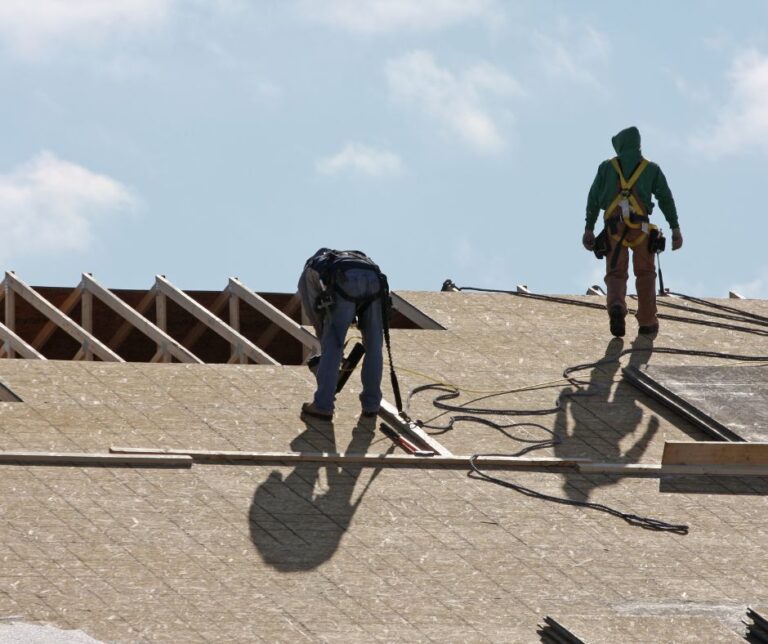
The crew shows up with a ladder, not a drone flyover as the only method. We walk the roof where it’s safe to walk and use a ladder and binoculars on steep or fragile sections rather than guess from the ground. Day one starts with the exterior: shingles or tile, flashing, valleys, ridge, gutters, and fascia. If there’s attic access, we go up and check the underside of the decking for water staining, daylight gaps, and insulation that’s been compacted or discolored by a slow leak.
You don’t need to be home for the roof walk, but we ask for access to the attic hatch and for pets to be secured. We’ll photograph anything that needs a closer look and talk you through it before we leave, then follow up with the written report. If we find something urgent, active water intrusion or decking that’s soft enough to be a safety concern, we’ll say so on site rather than wait for the paperwork.
Why Homeowners Choose GutterHawk
What it costs
A standard roof inspection in Maclay / Maclay Hammock runs {PRICE_LOW} to {PRICE_HIGH}. What moves the number: roof size and pitch, whether there’s full attic access or just a hatch, tile versus shingle (tile takes longer to walk safely), and whether you need the report formatted for an insurance carrier or a real estate transaction, which sometimes calls for additional documentation. A straightforward single-story shingle roof with easy attic access sits at the low end. A steep multi-slope tile roof with limited attic access sits at the high end.

Serving Maclay / Maclay Hammock From Two Locations
Common questions
Book a Roof Inspection
If a storm has been through, a sale is pending, or your insurer is asking questions, get it documented before the deadline rather than after. Call GutterHawk at 850-779-1081 to schedule a roof inspection in Maclay / Maclay Hammock FL, and tell us what the report is for so we can put together the right one.
Frequently Asked Questions
Q.1 How long does a roof inspection take?
Usually forty-five minutes to ninety minutes on site, depending on roof size and access. The report follows within a business day.
Q.2 Do I get a written report?
Yes, with photographs, severity ratings, and an estimate of remaining roof life.
Q.3 Is the inspection free?
If you are expecting repair work, the assessment is usually free. Standalone reports for insurance or a sale are a flat fee.
Q.4 How soon after a storm should I book?
As soon as it is safe. Claims have deadlines, and early documentation is far easier to support.
Q.5 Do you inspect the attic too?
Yes, where there is safe access. A lot of the useful evidence sits under the roof rather than on it.
Q.6 Will you push me toward a replacement?
No. If the roof has years left, the report will say so, and repair work is quoted separately.
Q.7 How often should a roof be inspected?
Every two years for a roof under ten years old, annually after that, and any time a significant storm passes through.
Working With Us Is Easy
01.
Request Your Quote
Getting the process started is easy! Simply fill out our quick form or call us at 850-656-4295. One of our friendly staff members will get in touch to finalize the details.
02.
We Work On Your Estimate
One of our expert estimators will get to to work analyzing your job and crafting a proposal. Of course, we’re here to answer any questions you may have.
03.
GutterHawk Gets To Work!
Contact Us
Have questions about your roof? Do you need information on gutter maintenance plans? No matter the question, GutterHawk is here to help!