

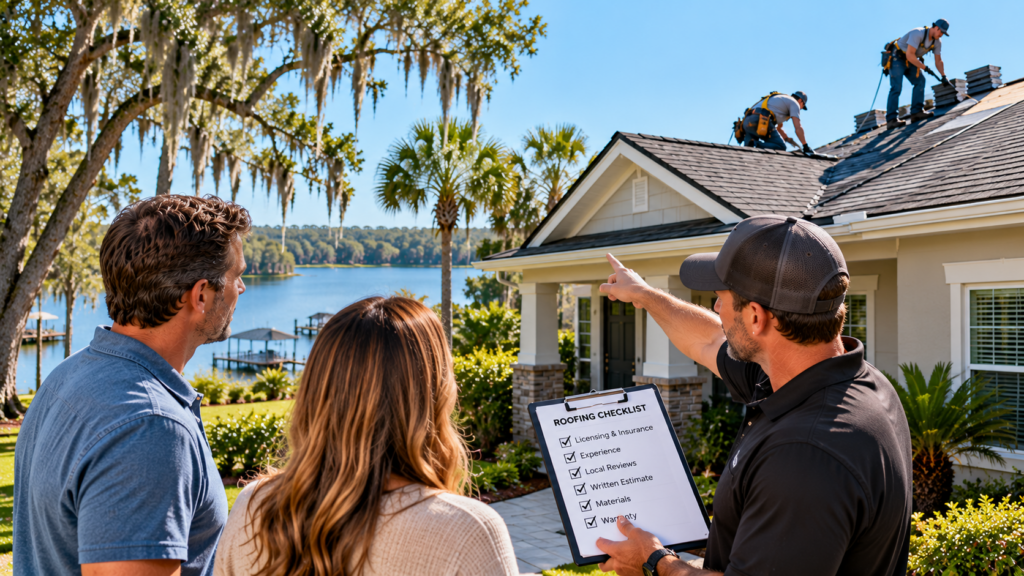
The best roofers in Duck Lake Point share four traits. They hold a valid license, carry insurance, write a detailed estimate and stand behind a warranty you can read. Check those first. Still, a friendly pitch or a low price tells you far less.
Start with the roof itself. Walk the yard and look for missing shingles, dark streaks and loose granules in the gutters. Then book a roof inspection so a licensed roofer can tell you what is actually wrong. Ask for photos from the visit, so you can hold every quote up against them.
Roofers in Duck Lake Point: license and insurance first
Florida requires roofing contractors to be licensed. Ask for the license number and look it up on the state’s license lookup yourself. For example, a photo of a card is not proof.
Then ask for proof of general liability and workers’ compensation coverage. A crew without it can leave you exposed if someone gets hurt, so skip any roofer who dodges the question.
What a good roof estimate visit looks like
A solid roof estimate takes some time. The estimator should look closely at every slope and check the attic or ceilings for stains. They should also inspect the gutters and fascia, because that is where water often shows up first. But if someone quotes you from the driveway in five minutes, keep looking.
Ask the estimator to show you what they find. A good one will point out worn flashing, cracked sealant and soft spots, then explain each.
Repair or replace? Ask for proof either way
A single leak does not always mean a new roof. Missing shingles, a cracked vent boot or bad flashing can often be fixed for far less. But widespread granule loss, repeated leaks and soft decking point toward roof replacement.
Whichever way the roofer leans, ask for close-up photos of the problem. If they cannot show you the issue, they should not be selling you the fix. Our view: the honest answer is sometimes a repair, and good roofers in Duck Lake Point will say so.
Structure matters here too. GutterHawk holds both a roofing and a building contractor license. So if the crew finds rotted decking or framing, we fix it in house instead of hiring another company.
Read the estimate line by line
A good estimate names the shingle brand and line, the underlayment, flashing, drip edge and ventilation. It also gives a price for replacing rotted decking, because that surprise most often raises the final bill. Cheap quotes often leave these items out. So compare line by line, not total by total.
Also ask who pulls the permit and whether cleanup is included. For example, a good crew sweeps the yard with a magnetic tool for stray nails. Ask for a start date and a finish window in writing, so weather delays do not become excuses.
Warranties and storm-season red flags
Two roof warranties matter: the shingle manufacturer’s and the roofer’s workmanship coverage. Get both in writing and ask what happens if you need to make a claim later. A roofer certified by GAF or CertainTeed can often offer stronger manufacturer warranty options, though terms vary by product.
Tallahassee deals with hurricane season, summer thunderstorms and long humid stretches. After storm damage, out-of-town crews often knock on doors. Be wary of high-pressure pitches, large upfront deposits and anyone who will not give local references. Ask for addresses of recent jobs nearby, then drive past them.
Keep every document in one folder. You may need it later for an insurance claim or a sale.
Conclusion
Picking from the roofers in Duck Lake Point comes down to proof. Verify the license, see the insurance, read the estimate and get the warranty in writing. GutterHawk has been a Tallahassee roofing company for more than 20 years, and we are GAF and CertainTeed certified. We will walk you through what your roof needs and what it does not. If cost worries you, ask about financing through Wisetack. It covers up to $15,000, with 0% APR for qualifying customers. Call GutterHawk at 850-779-1081 for a free estimate.
Frequently Asked Questions
Ask for the license number, then look it up on the state’s online license lookup. Confirm the name matches the company on your estimate and that the license is active. Also ask for proof of general liability and workers’ compensation insurance, and check that the policies are current before any work starts.
Get at least two or three, because one quote gives you nothing to compare. Make sure each one covers the same materials and scope, including decking, flashing and cleanup. If one price is far lower, find out what it leaves out before you get excited about the savings.
Many homes take a few days, but it depends on the size, the roof’s complexity and the weather. Rotted decking can add time. Ask your roofer for a start date and a finish window in writing, and ask how rain delays will be handled.
A deposit is common, but keep it modest and get the terms in writing. Be careful with anyone who demands a large amount upfront or full payment before work starts. Ask for a payment schedule tied to progress, and never pay in cash without a signed receipt.
Stay safe and stay off the roof. Take photos of the damage from the ground, move belongings away from leaks, and call your insurer. Then get an estimate from a local roofer. Keep receipts for temporary repairs, since your insurer may ask for them.