

If you’ve ever asked a roofer for a quote, you’ve probably heard, “Your roof is about 28 squares.” That can sound like jargon, but a roofing square is simple, and understanding it helps you read estimates with confidence and compare bids fairly.
What Is a Roofing Square?
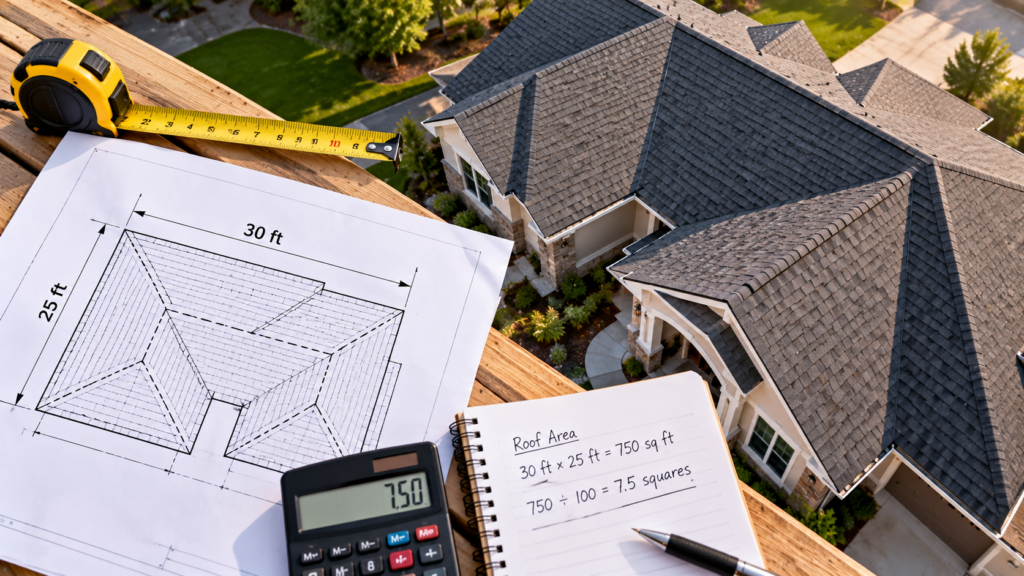
A roofing square is a unit of measurement equal to 100 square feet of roof surface. It’s the standard way roofing contractors and suppliers measure and price a roof, because it keeps the numbers manageable. Saying “25 squares” is easier than “2,500 square feet,” and it makes material orders and labor estimates consistent across the industry.
A roofing square measures the roof’s surface area, not the footprint of your house. That difference matters more than most homeowners expect.
Why Roofers Use Squares Instead of Square Feet
Roofing materials are sold and priced in units that line up neatly with squares. Shingles, underlayment, and many other products are packaged to cover a set area, so squares make ordering and pricing straightforward. When you compare quotes, “price per square” lets you judge bids on equal footing, even when the roofs being quoted are different sizes.
How to Calculate Roofing Squares
You can get a rough estimate yourself, though a professional measurement is always more reliable.
- Find the roof’s surface area. For a simple gable roof, multiply the length by the width of each roof section, then add the sections together.
- Account for pitch. A steeper roof has more surface area than a flat one covering the same footprint. Roofers apply a pitch multiplier to adjust for this.
- Divide by 100. The result is your number of squares.
Example: If your roof surface measures 2,400 square feet, that’s 24 squares.
Complex roofs with valleys, dormers, hips, and chimneys take more careful measuring, which is why a professional inspection gives a far more accurate number than a rough calculation.
Don’t Forget the Waste Factor
Materials are never ordered at exactly 100% of the measured area. Shingles get cut at edges, valleys, and ridges, and some are lost to damage or mistakes. Roofers typically add a waste factor of around 10 to 15 percent, and more for roofs with lots of angles.
So that 24-square roof might need enough material to cover 26 or 27 squares. Ask your contractor how they account for waste so you understand what’s included in your estimate.
How Many Shingle Bundles Are in a Square?
Most shingles are sold in bundles, and a square typically takes three bundles, though this varies by product. Some heavier architectural or specialty shingles may need four. Check the manufacturer’s coverage details for the exact shingles on your project.
Why Roofing Squares Matter to You
Knowing the term helps you in three practical ways:
- Comparing quotes. If one estimate says 24 squares and another says 30 for the same house, you know to ask why.
- Understanding scope. Squares tie directly to how much material and labor your project requires.
- Spotting errors. A figure that seems far too high or low is worth questioning.
Whether you’re planning a roof replacement or budgeting for roof repairs, the number of squares is the foundation of your estimate. If you’re not sure where your roof stands, a professional roof inspection can confirm its condition and give you accurate measurements before you commit to a project.
Get an Accurate Measurement in Tallahassee
At GutterHawk, we’ve served Tallahassee homeowners and builders for over 20 years, and we’re certified as both roofing and building contractors. We measure carefully, explain every line of your estimate, and offer free estimates so you know exactly what you’re paying for. Call us at 850-779-1081 or email [email protected] to get started.
Frequently Asked Questions
One roofing square equals 100 square feet of roof surface.
No. A roofing square measures the roof’s surface, which is usually larger than your home’s footprint because of pitch, overhangs, and added features like dormers.
It depends on the home’s size and roof design. Many single-family homes fall somewhere between 15 and 30 squares, but complex rooflines can push that higher.
Typically three bundles, though some thicker shingles require four. Always confirm with the manufacturer’s specifications.
You can estimate, but pitch, valleys, and waste factors make DIY measurements easy to get wrong. Climbing a roof also carries safety risks, so having a professional measure it is the safer and more accurate route.