

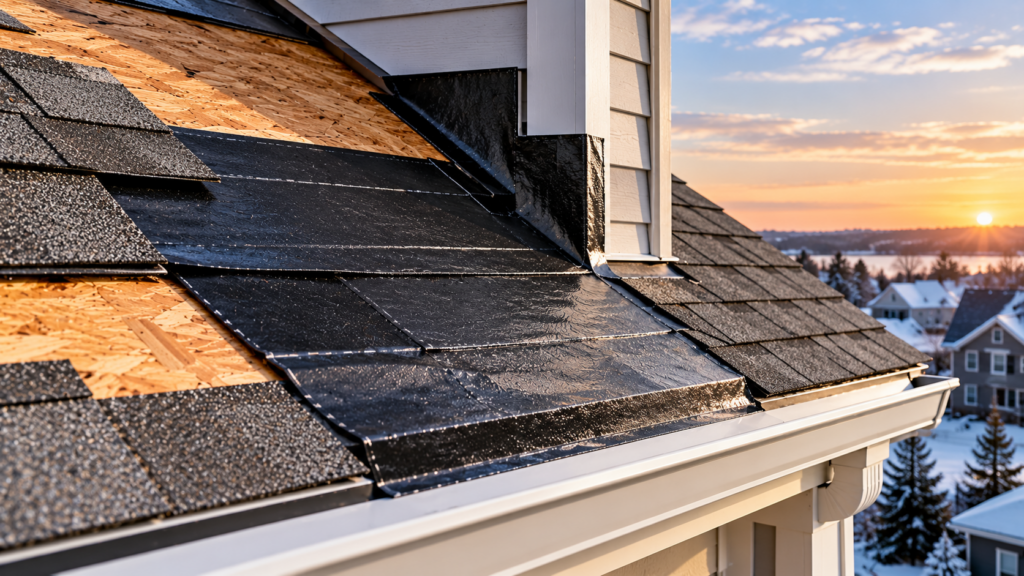
If a roofer has ever mentioned “ice and water shield,” you may have wondered what it is and whether your home needs it. Despite the name, it isn’t only for snowy climates. In Tallahassee, where heavy downpours, tropical storms, and wind-driven rain are common, it can be one of the smartest additions to a roofing project.
What Is an Ice and Water Shield?
An ice and water shield is a self-adhering waterproof membrane installed beneath your shingles or other roof covering. It is usually made of rubberized asphalt or polymer-modified bitumen, with a sticky backing and a peel-off liner. Once the liner is removed and the membrane is pressed onto the roof deck, it bonds directly to the wood.
Traditional felt and synthetic underlayments are held down by fasteners. An ice and water shield seals tightly around the nails that pass through it, which is what makes it so effective at stopping leaks.
How Does It Protect Your Roof?
Roof leaks rarely begin in the middle of a shingle field. They start where water is pushed, pooled, or forced under the roofing material. In cold regions, ice dams back meltwater up beneath the shingles. In Florida, the same problem shows up as wind-driven rain during storms, which can blow water sideways and under shingles or flashing.
The shield is a last line of defense. Even if water gets past the outer layer, it meets a watertight barrier instead of your roof deck and attic.
Where Is It Installed on a Roof?
Most roofers apply it only in the areas most prone to leaks:
- Eaves: the lowest edge of the roof, where water collects and backs up.
- Valleys: where two roof planes meet and water runs fastest.
- Penetrations: around chimneys, skylights, plumbing vents, and other openings.
- Wall and dormer intersections: joints where roofing meets vertical surfaces.
- Low-slope sections: areas where water drains more slowly.
In storm-prone regions, some homeowners also have the membrane installed across the entire roof deck as a secondary water barrier.
Do You Need It in Tallahassee?
Ice dams are rare here, but the product is far from pointless. Our area gets intense summer thunderstorms and hurricane-season weather, and a self-adhered membrane adds meaningful protection in vulnerable spots. Requirements depend on your roof type, slope, and local building code, so a licensed contractor should confirm what your home needs.
Key Benefits
- Stronger leak protection: it creates a watertight seal where leaks are most likely.
- Self-sealing around nails: it reduces the small openings fasteners can leave behind.
- Deck protection: keeping moisture off the wood helps prevent rot and mold.
- Added resilience in storms: it provides backup when wind and rain test your roof.
Things to Keep in Mind
An ice and water shield doesn’t replace good workmanship. It needs a clean, dry deck, correct overlaps, and a smooth application without wrinkles. this also less breathable than standard underlayment, so covering a whole roof deck calls for proper attic ventilation. It costs more than felt, which is why many roofers use it selectively rather than everywhere.
When to Talk to a Roofing Professional
The best time to add one is during a roof replacement, when the old roofing is removed and the deck is exposed. If you’re unsure about your current roof’s condition, a roof inspection can show whether leak-prone areas such as valleys and eaves are properly protected. If you already have a problem, our roof repairs team can find the source and recommend the right fix.
Protect Your Home With GutterHawk
For over 20 years, GutterHawk has helped Tallahassee homeowners protect their roofs with quality materials and expert installation. Call us at 850-779-1081 or email [email protected] to schedule a free estimate.
Frequently Asked Questions
It isn’t needed to fight ice dams, but it helps against wind-driven rain and storm leaks. Many homeowners add it to valleys, eaves, and penetrations for extra protection. Your roofer can advise based on your roof and local code.
It is most often installed along eaves, in valleys, around chimneys, skylights, and vent pipes, and at wall and dormer intersections. It can also cover the full deck as a secondary water barrier.
No. Roofing felt and synthetic underlayment are fastened to the deck and can leave tiny openings around nails. Ice and water shield is a self-adhering rubberized membrane that seals around fasteners, which makes it more waterproof.
Yes, in some cases. Because it’s less breathable, full-deck coverage requires proper attic ventilation. A roofing professional can tell you whether it makes sense for your home.
It is normally installed directly on the bare roof deck, so it goes in during a roof replacement or major repair. It can’t be added beneath shingles that are already in place.